"Can you tell me how that structure will withstand that kind of pressure?"
That question came from Bill Finan, a Center Grove Neighbors member, at a public meeting about the City of Miami's proposed berm at Peacock Park. He was asking about a six-foot shoreline structure the city itself is building with grant money, an engineering team, and years of public planning behind it. It is a fair question to ask about a $2 million public project. It is an even more urgent question to ask about the piece of concrete or steel sitting at the edge of a private lot you are about to buy for eight or nine figures.
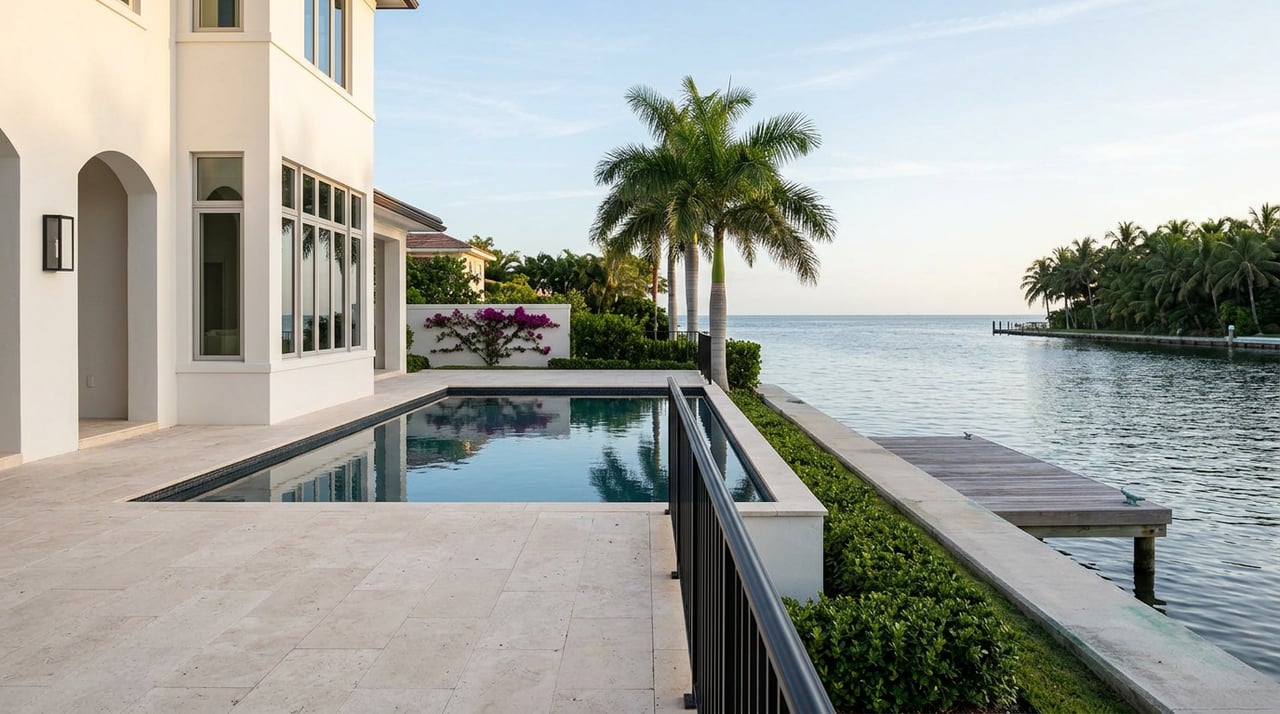
Buyers evaluating a Coconut Grove waterfront estate already know to ask for the elevation certificate. Insurance brokers have made that request routine. What most buyers do not ask for, and what rarely appears on a spec sheet, is the seawall's own paper trail: when it was built, whether it was ever permitted, and whether it meets the standard the county now requires for anything built or rebuilt today. That gap in the standard diligence checklist is where a Grove closing either stays on schedule or slips by months, and where two estates that look identical on a listing sheet can carry very different budgets the year after closing.
The Wall Isn't Part of the House. It's Its Own Permit.
A seawall or dock along Biscayne Bay in Coconut Grove is regulated separately from the home behind it. Structural work runs through the City of Miami Building Department's Chapter 29 waterfront review, and any construction, replacement, or repair touching the water itself needs a Class I Coastal Construction Permit from Miami-Dade County's Department of Environmental Resources Management. New and replacement walls along the bay are expected to reach a crest elevation of 6.0 feet NAVD88, and because the Biscayne Bay Aquatic Preserve covers the adjacent water on most bay-fronting Grove parcels, state law under Florida Statute 258.397 requires riprap toe protection to be incorporated into new or replacement construction.
None of that has anything to do with the home's flood insurance rating. It is a separate file, and in Coconut Grove, the file's age varies enormously from one lot to the next. The neighborhood's housing stock runs from 1920s-era estates to recent rebuilds, and the seawalls along that same stretch of shoreline range just as widely, from original mid-century construction to work completed under current code. A wall poured before the county had a 6.0 foot standard was, by definition, never required to meet it, and unless it has been replaced since, it likely does not.
What the City's Own Calendar Says About the Grove's Shoreline
The clearest evidence that this is a real, present-tense problem and not a hypothetical one comes from the city's own capital works schedule. The City of Miami has a funded project called Brickell and Coconut Grove Seawalls Improvements, with construction scheduled to run from June 2026 through January 2027. A municipality does not put a seawall replacement on a multi-year capital calendar unless the existing infrastructure has aged past the point of routine maintenance.
The Peacock Park shoreline project tells the same story from a different angle, and at a smaller scale that makes the friction easier to see. By last year, city officials had already spent more than two years planning a 450-foot hybrid berm there, with only the design and permitting phase fully funded, at roughly $465,000, while the actual construction, estimated near $1.6 million, remained unsecured. Finan's question about the structure's ability to withstand storm pressure was one of several raised at a public meeting, alongside concerns from other residents about tree canopy loss and whether the berm would simply push floodwater into the neighboring Sailing Club and Cloisters properties instead of stopping it.
That is a public project, with a dedicated engineering team, state grant funding, and a City of Miami capital improvements office managing the timeline, and it still took years to move from concept to a contested design. A private homeowner replacing a failing seawall is working with the same regulatory apparatus, the same DERM Class I process, and the same Aquatic Preserve requirements, without a grant covering the permitting cost. The city's own experience with its own shoreline is the most honest available estimate of how long this work actually takes.
Two Estates, Two Very Different Years Ahead
Consider two Grove waterfront lots on comparable bay frontage, priced within a few million dollars of each other. The difference that matters most may not be square footage or finish level. It may be which decade the seawall was built in.
| Older wall, no recent permit history | Recently rebuilt wall | |
|---|---|---|
| Construction era | Mid-century or earlier | Rebuilt to current standard |
| Crest elevation | Often below 6.0 ft NAVD88 | Built to meet 6.0 ft NAVD88 |
| Aquatic Preserve riprap | Frequently absent | Incorporated per F.S. 258.397 |
| Permit file at closing | May be incomplete or missing | Class I permit and final inspection on record |
| Likely near-term repair cost | $100 to $250 per linear foot for standard repair, up to $600 per linear foot for severe structural work | Minimal, if any |
| Timeline if work is needed | Several months at minimum for a new DERM application, longer with habitat, water depth, or neighbor objections | Not applicable |
A buyer who treats both properties the same at the offer stage is pricing in a risk that may or may not ever come due. A buyer who asks the seawall question up front is pricing in a known cost, or discovering there isn't one.
The Documents That Belong in Diligence, Not After Closing
For a Coconut Grove waterfront purchase, the seawall and dock file deserves the same early attention as title work. That means requesting, before the inspection period closes:
- The Class I Coastal Construction Permit and final inspection record for the seawall and any dock
- Documentation of the wall's crest elevation relative to the 6.0 ft NAVD88 standard
- Confirmation of riprap or toe protection where the Aquatic Preserve applies
- Any open, expired, or unresolved permits tied to the waterfront edge
- A marine engineer's condition assessment where the seller cannot produce complete permit history
- Whether tree protection review affected past waterfront work, since mature ficus, banyan, and gumbo limbo canopy near the shoreline can add engineering and logistics to any future repair
A seller who assembles this file before listing removes a point of friction that would otherwise surface during due diligence. A buyer who asks for it before writing an offer is pricing the property on its actual condition rather than its curb appeal.
Why This Belongs in the Offer, Not the Punch List
This matters most in the stretches of the Grove where the age spread is widest: South Bayshore Drive, the Sailboat Bay and Tigertail Avenue corridor, Bay Heights, and the Camp Biscayne and Entrada enclaves, where estate lots dating to the 1920s sit alongside recent teardowns and rebuilds along the same run of bay frontage. The market in these pockets has not slowed down while this diligence gap persists. A contemporary estate on Kiaora Street sold for $22.5 million in August 2026, and reporting on relocation buyers coming to South Florida has described more than $170 million in Coconut Grove waterfront purchases by a single buyer in recent transactions. Deals at this scale move quickly once terms are agreed. The seawall question is one that needs to be answered before that speed takes over, not after.
Treating the wall as a closing document rather than a decorative feature changes the conversation with a seller, the terms of an offer, and the first-year budget for a buyer. It is a small piece of paper that tells you more about what you are actually buying than the listing photos do.
Frequently Asked Questions
Does every Coconut Grove waterfront lot need a Class I permit for seawall or dock work? Most seawall replacement and dock construction touching tidal water requires a Class I Coastal Construction Permit from Miami-Dade DERM, alongside the City of Miami's Chapter 29 waterfront review. Routine cap or tieback repairs may qualify for an expedited authorization, but new construction and full replacements go through the standard process.
What if the seller cannot produce permit records for the seawall? A marine engineer can complete a condition assessment above and below the waterline, which gives a buyer a factual basis for negotiating price or requesting remediation before closing, even without a complete permit history.
Does the city's Brickell and Coconut Grove Seawalls Improvements project affect my private lot? That project addresses city-managed infrastructure on its own schedule. It does not substitute for a private owner's own permit and maintenance responsibility, but its multi-year timeline is a useful reference point for how long comparable work actually takes in this jurisdiction.
Why does tree canopy come up in seawall conversations? Coconut Grove's tree protection rules are among the strictest in Miami, and mature trees near the shoreline can affect how repair work is engineered and scheduled, since root zones and canopy protection factor into the construction method a contractor can use.
If you are evaluating a waterfront estate in Coconut Grove, or preparing one for sale, the seawall's permit history deserves the same early attention as the title search. Cassis Burke Collection works this diligence into every waterfront transaction from the first conversation. Request a private consultation to walk through what a specific property's shoreline file actually shows.